
The proposal · Updated November 13, 2026
Room to turn.
Room to keep moving.
A simpler first step for 38th Avenue North.
Start with a dedicated, clearly marked place for turning traffic to wait. Test the simplest effective solution first.
Organized by The Jungle · Community concept, not an approved design
Separate the queue.
02Protect the through movement.
03Measure whether it works.
Start simple. Verify the place.
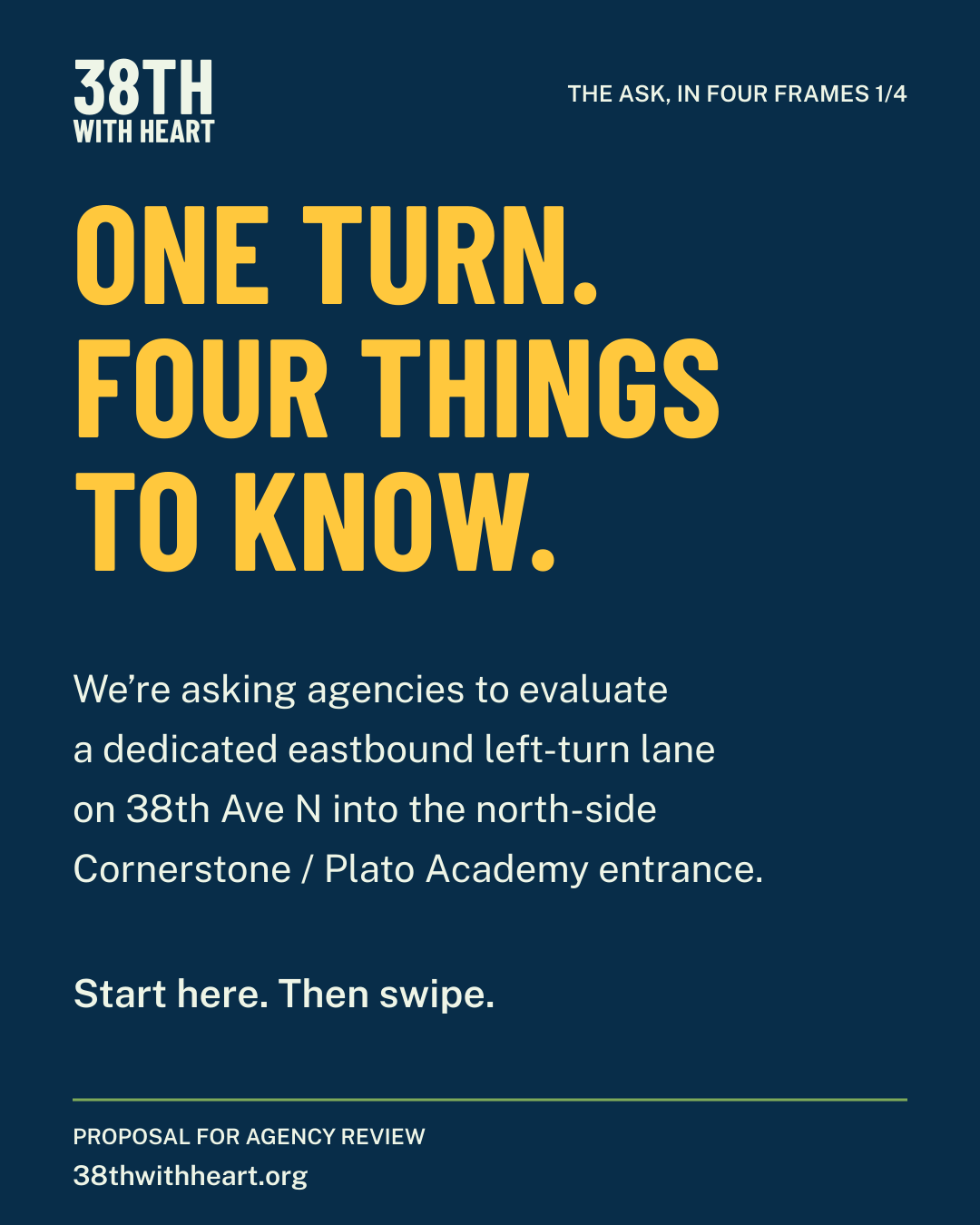
The best solution is often the simplest effective one. Before accepting a complicated rerouting scheme or a major reconstruction project, we should test a straightforward idea: give drivers making the eastbound left turn into the shared Plato frontage entrance a clearly marked, properly designed place to wait outside the through lanes.
That is the plan we advocate evaluating first. It is a proposal, not an approved engineering design. Whether it can be delivered mainly through markings, requires physical work, or is unsuitable depends on the actual roadway and a focused safety review.
The frontage serves 6725/6745 38th Avenue N, west of 66th Street N. The preferred concept concerns an eastbound left-entry movement. Agencies must confirm the exact entrance, signs and permitted movements. Campus location · Shared frontage location.
Executive summary
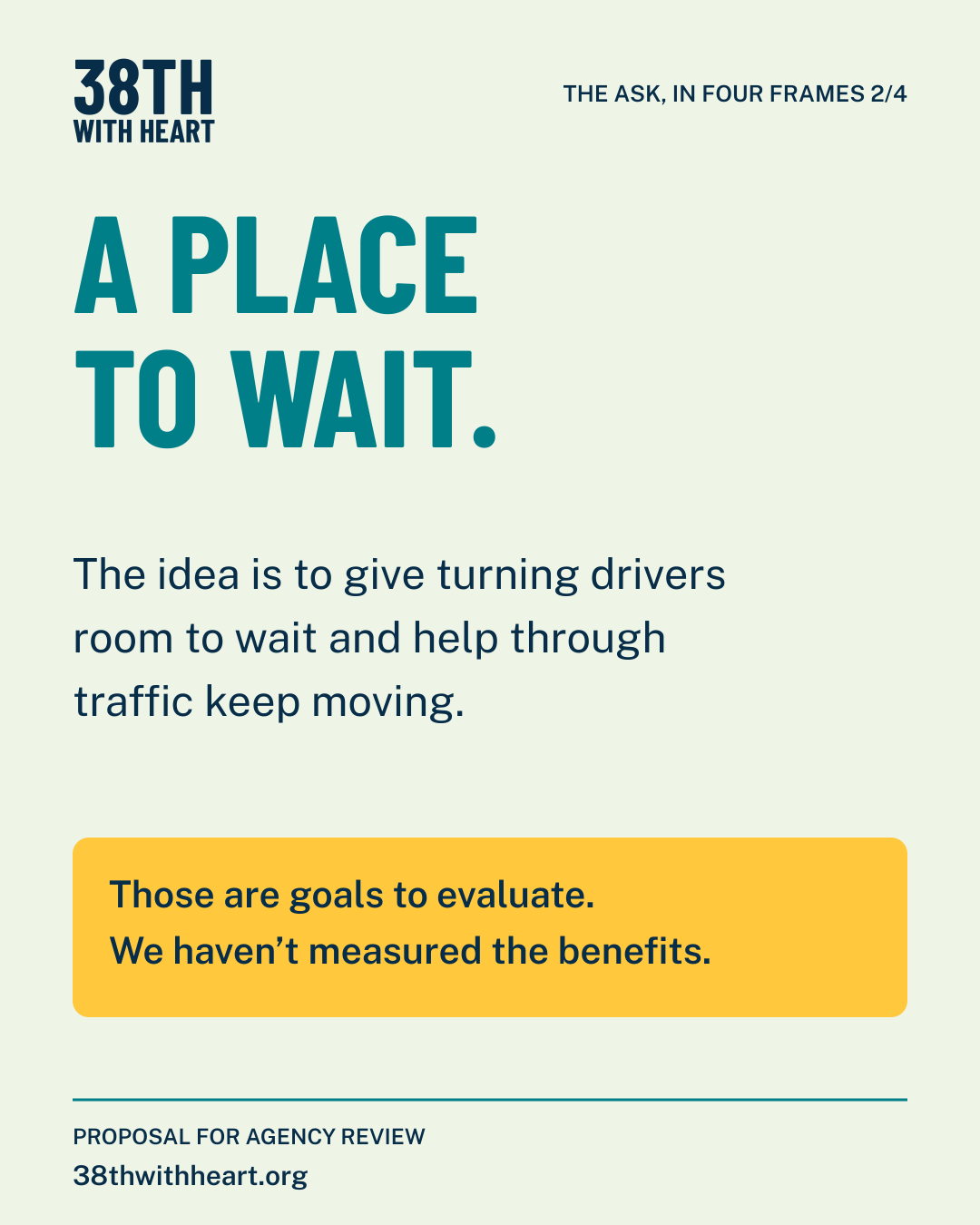
Our preferred concept is a dedicated center left-turn pocket with usable queue storage, clear approach markings and an approved opening into the shared driveway serving the 6725/6745 38th Avenue N frontage. The purpose is simple: separate waiting left-turn traffic from traffic continuing along 38th Avenue, without creating new conflicts or obstructing adjacent access.
We ask the responsible agencies to identify the exact entrance and permitted movements, measure the space and school-peak queues, and compare this concept with a shared two-way center turn lane and other reasonable options. Choose the least complex treatment that safely meets the demonstrated need. If the dedicated pocket cannot fit or would create unacceptable conflicts, explain why and identify the simplest feasible alternative.
This independent community request supports a safe, accessible school and a functioning neighborhood. It is not sponsored or endorsed by the school, property owner, businesses or public agencies. It does not ask school staff to carry a new advocacy burden.
The problem to test
John Small reports that some drivers arriving from the west loop around before joining the school-entry queue, and that queues can reach toward 66th Street and affect Publix access. These are resident observations and a routing hypothesis, not a completed traffic study. The exact travel direction, queue tail and affected curb cuts must be plotted during observation rather than inferred from informal descriptions.
The hypothesis is that clearer, lawful direct entry with sufficient off-through-lane storage could reduce unnecessary circulation and through-lane blockage. That benefit is not yet measured. A turn pocket cannot solve a queue caused by inadequate receiving capacity inside a driveway, and additional storage does not create safe gaps in opposing traffic.
The September 2026 Pinellas Community Traffic Safety Team minutes discuss 38th Avenue/66th Street and a school-driveway exit movement. They do not establish the legality of our proposed entry movement or constitute approval of a Plato turn lane. September CTST minutes
Our preferred concept: a dedicated marked center turn pocket
- An unmistakable approach. Approved directional markings and signs tell drivers where the turn begins and where they must not queue or cross.
- A real waiting area. A dedicated pocket stores the measured design queue outside the through lanes. Paint clarifies space; it does not create width or guarantee capacity.
- An approved driveway connection. Confirm the lawful opening, turning path and driveway receiving capacity before changing markings or access.
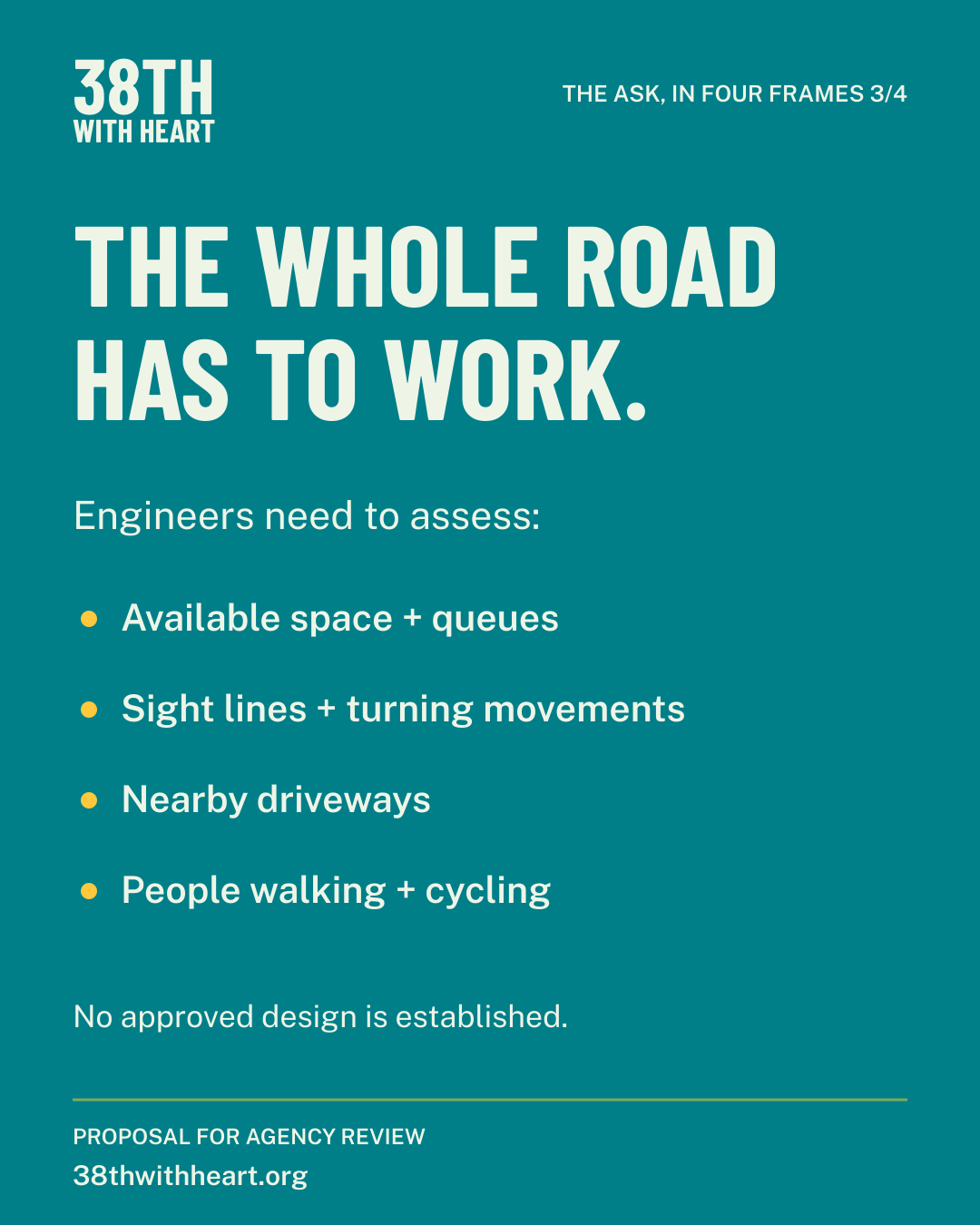
- Protection for everyone using the corridor. Preserve pedestrian and bicycle movements, sight lines, drainage, emergency access and neighboring driveways. Check opposing turns and interaction with the 66th Street signal.
- A measured result. Compare queue spillback, through-lane blockage and observed conflicts before and after any agency-approved change.
Why start here? A focused turn-storage treatment directly addresses the separation of waiting and through traffic. FHWA identifies dedicated turn lanes as a way to accommodate slowing and waiting vehicles, while also emphasizing that design and context matter. We are not applying a generic crash-reduction percentage to this driveway. FHWA: dedicated turn lanes
Figure 1. Conceptual movement sequence
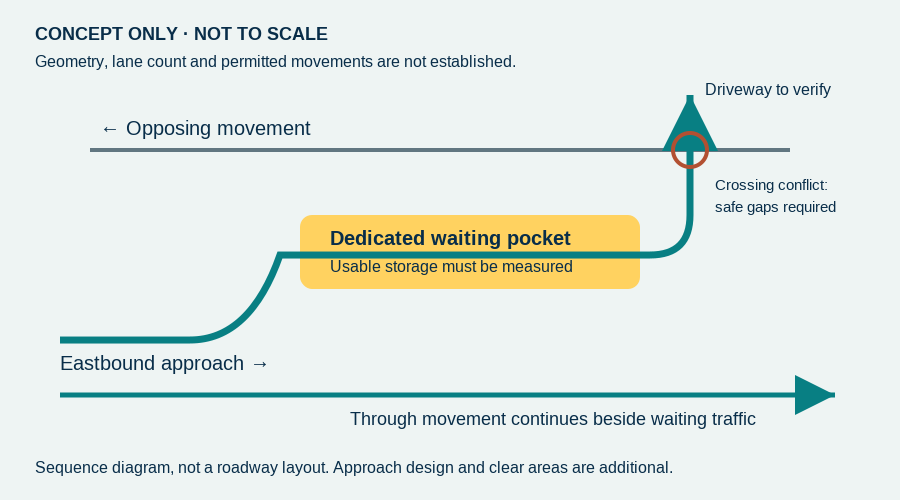
Eastbound approach → approved entry taper/deceleration → dedicated waiting pocket → left turn into driveway subject to verification
Through traffic continues beside the waiting pocket. The left-turn path crosses opposing traffic only when lawful and safe. The pocket is not an extra through lane and is not a place to bypass a queue.
Figure 2. How much space does a waiting queue use?
Site measurement comes first. Available approach width and usable queue-storage length have not been verified. Earlier aerial-based storage estimates were withdrawn as unverified and are not a basis for design or capacity conclusions. Measure the actual upstream approach, driveway location, existing turn-pocket transitions and required clear areas before deciding whether any storage scenario fits.
The arithmetic below explains how assumptions change required space. It does not establish available space at this frontage, feasibility, or the maximum queue. No measured fit or non-fit conclusion is claimed.
This sensitivity illustration assumes 25–30 feet per passenger vehicle including its standing gap. It is arithmetic for discussion, not measured local vehicle spacing or a design recommendation. The 25-foot end is consistent with the vehicle/length examples in FDOT's queue guidance; the 30-foot end is an explicitly selected larger-space scenario. Buses, trucks and real driver behavior can require more.
| Passenger vehicles waiting | At 25 feet each | At 30 feet each |
|---|---|---|
| 4 | 100 feet | 120 feet |
| 6 | 150 feet | 180 feet |
| 8 | 200 feet | 240 feet |
| 10 | 250 feet | 300 feet |
Calculation: standing storage = vehicle count × assumed occupied length. These lengths exclude the additional approach/deceleration/taper design and any necessary clear areas. We have not established that any listed length fits this frontage. A 150-foot pocket is not evidence that a six-car queue will be the maximum.
FDOT's 2026 Design Manual says queue length should be based on a traffic study and treats auxiliary lanes as more than standing storage. Its low-volume examples are not a substitute for observing a concentrated school peak. Pinellas County's published manual states that the County selects the applicable turn-lane reference during review. Therefore we propose no final width, taper or total length. FDOT 2026, §212.14 · Pinellas County manual, §9.5
Compare the alternatives fairly
| Option | What it could accomplish | What must be resolved |
|---|---|---|
| Dedicated center left-turn pocket: preferred first study | Separates one defined entry queue from through traffic | Width, storage, safe gaps, sight distance, driveway capacity and nearby conflicts |
| Shared two-way left-turn lane | Serves multiple nearby left-turn destinations | Opposing queues, overlapping turn paths, driveway spacing and misuse; it is not dedicated school queue space |
| Clarify existing lawful movements with markings/signs | Potentially simpler correction where confusion is the main problem | Does not add storage; insufficient if the queue still blocks through traffic |
| Restricted access or rerouting | May remove particular crossing conflicts | May shift queues, U-turns and traffic to other access points; assess the whole network |
| Geometry or signal changes | May be necessary where simpler treatments fail | More complex design, rights-of-way, utilities, funding and construction impacts |
The comparison should consider all road users, not only the convenience of one movement. FHWA's access-management guidance includes multiple techniques; no one treatment is universally best. FHWA: corridor access management
What is known, and what is not
Documented: An engineering-review request was sent October 9. County Traffic Operations acknowledged it October 26. A focused follow-up was sent November 13 requesting a coordinating contact, case number, current-access guidance and alternatives assessment. An acknowledgment is not an engineering determination or approval.
Existing geographic evidence: Our October 9 County GIS review provisionally identified County-coded frontage road maintenance and a parcel within St. Petersburg. Road ownership, signal responsibility, driveway permits and municipal boundaries are different questions. Written, asset-specific jurisdiction confirmation remains outstanding.
Not yet measured or confirmed: Exact active curb cut; current permitted entry and exit movements; available center width; usable storage distance; design/operating speed; turning counts; representative maximum and 95th-percentile queues; blockage duration; safe gaps; driveway receiving capacity; attributable crash history; utilities, drainage and right-of-way constraints.
No responsible price or schedule yet: No survey, quantity takeoff, agency scope or contractor estimate supports a construction cost. “Paint-first” should mean evaluating a low-complexity treatment first, not promising that a paint-only fix is feasible or cheap.
A practical agency decision request
Please provide one coordinated, written response that:
- Names the lead agency and responsible engineer, with one cross-referenced case number.
- Identifies the exact driveway, current permitted movements and the relevant approved plans or permits.
- Establishes the minimum observation and geometry checks needed to compare the alternatives.
- Tests the dedicated marked center-storage concept first, including its effect on through traffic and adjacent access.
- Explains any rejected alternative and identifies the simplest safe, feasible improvement, its next approval step and an achievable review timetable.
Use representative arrival and dismissal observations on multiple ordinary school days, with abnormal conditions identified. Record turning counts, queue extent, blocked-access time and whether the internal driveway queue prevents entry. Evaluate the downstream 66th Street intersection as part of the system, not as a separate problem.
FDOT has a separate 66th Street/SR693 resurfacing project in design between Tyrone Boulevard and Park Boulevard, with construction anticipated in spring 2029. That is a potential coordination opportunity, not evidence that this driveway is included or that a nearer-term improvement must wait until 2029. Official project 451239-1-52-01
The ask
Start simple. Measure what matters. Give turning traffic a safe place to wait if the space and evidence support it.
We are asking for a fair, timely engineering evaluation of a practical proposal, not a predetermined approval. Keep the neighborhood moving, preserve safe access and choose the simplest solution that genuinely works.
The 18-second introduction
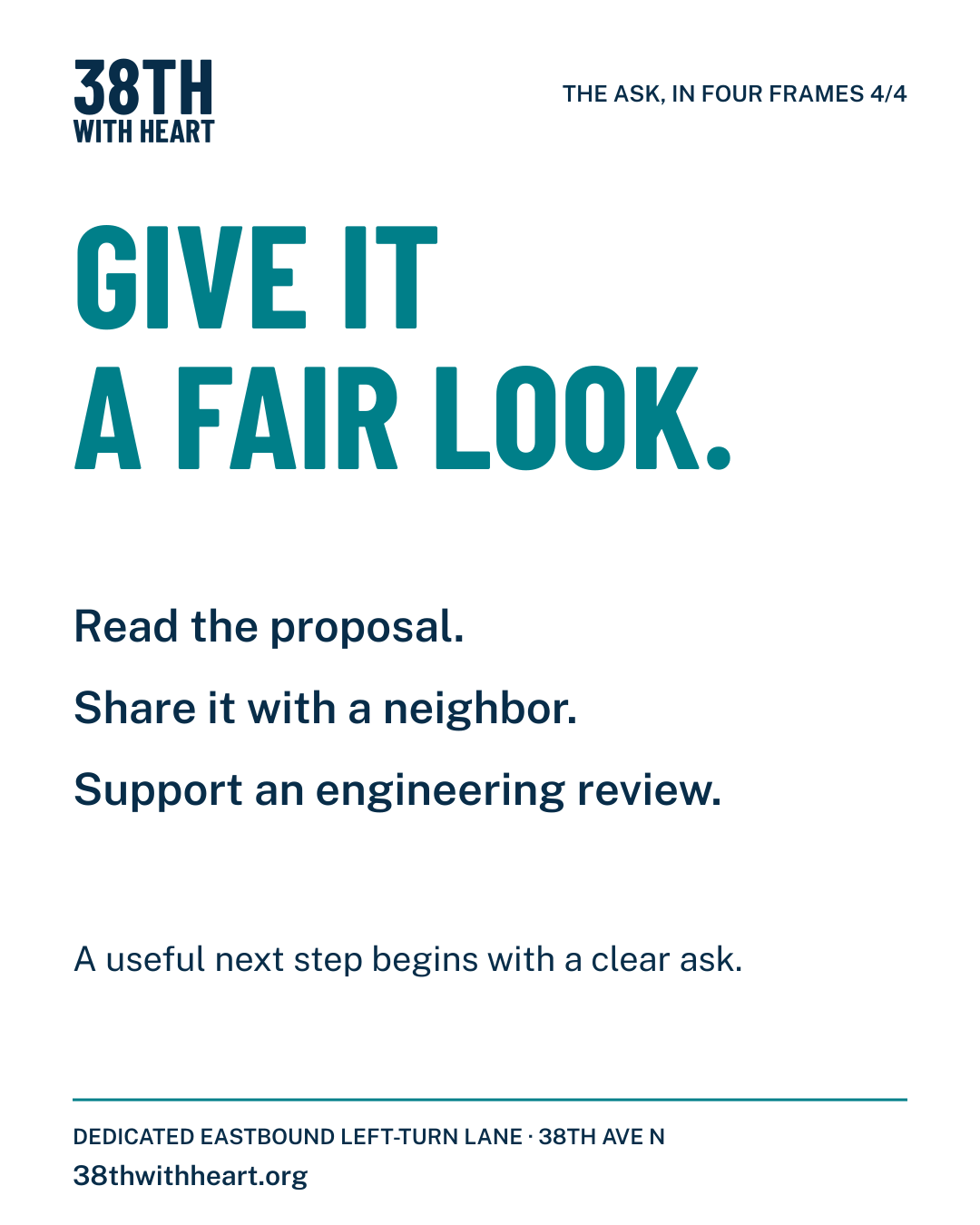
See the four-frame visual explainer
Sources & scope
Official engineering and agency sources are linked beside the claims they support. Reviewed November 13, 2026. Resident reports are identified separately from public records. The concept and storage scenarios are not surveyed dimensions, an approved design, or a promise of construction.